
We need to talk about : What is a Recipe?
What exactly is a recipe? Is it simply a set of instructions—or something far more complex?
Recipes travel across borders, languages, and centuries time. They tell us about ourselves, our pasts, and how we live and eat today. In an age of AI and data, how are recipes being transformed to shape access to and knowledge about culinary history?
This Kitchen Table conversation brings together researchers, technologists, and cultural practitioners from the Horizon Europe project RELISH to explore recipes as living forms of cultural heritage. From medieval manuscripts to modern databases, from reconstructed dishes to algorithmic models, the discussion asks how food knowledge is captured, transformed, and sometimes lost.
How can technology help us understand the past without flattening its complexity? What gets lost when taste cannot be archived? And can recipes help us rethink belonging in a globalised food landscape?
This session focuses on data, AI, and the conceptual challenges of working with recipes as cultural knowledge. It also opens the door to further conversations after this summer, shifting towards cooking, practice, and lived experience—exploring what happens when historical recipes are brought back to life.
Join us for an open, thought-provoking exchange that invites you to see new ways of using recipes to tell dynamic stories about who we are.
This event brings together contributors and thinkers who are reshaping how we understand food — not just as something we consume, but as something that connects us to each other and to our histories.
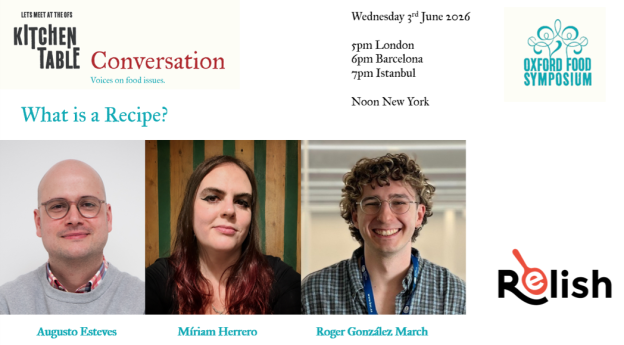
Leading the conversation will be:
Augusto Esteves, Associate Professor of the Department of Computer Science and Engineering at Instituto Superior Técnico, University of Lisbon, where he leads the Human-Computer Interaction (HCI) Lab. He has held visiting positions in the departments of mechanical engineering (KAIST), industrial design (TU Eindhoven), and design (UNIST); and has been a visiting professor at POSTECH, LMU Munich, and Lancaster University. He frequently publishes in international venues that cover a wide range of topics, including the technical aspects of HCI, human factors, tangible and embodied interaction, design, and, more recently, spatial computing (or extended reality, XR). He has further developed multi-sectoral experience through a research fellowship at Siemens, where he helped develop a head-mounted solution for field engineers, and via research projects on XR with Samsung and NVIDIA.
Míriam Herrero, senior researcher at the Barcelona Supercomputing Center, where her work focuses on network science, data visualization, and the intersection of arts and science. Previously, she built a prolific career in theoretical physics, holding positions at the Instituto de Física Teórica UAM-CSIC (Spain), the École Polytechnique Fédérale de Lausanne (EPFL, Switzerland), and the Scuola Internazionale Superiore di Studi Avanzati (SISSA, Italy). Over the course of her career, she has been awarded several prestigious fellowships. More recently, her work on mobility and accessibility in modern cities received an award from the Madrid City Council.
Roger González March, complex systems researcher at the BSC Creative Intelligence Lab (Barcelona Supercomputing Center), at the intersection of advanced computation and the Cultural and Creative Industries — within RELISH, he applies AI and natural language processing to identify ingredients, tools, and culinary actions in medieval recipes, transforming them into structured knowledge graphs. A first dataset is openly available on Zenodo, and the team is now working toward a larger corpus drawn from as many surviving manuscripts as possible, with the goal of automatically extracting recipes from historical sources.
Facilitated by Rosi Song, Simon A. Thibault, David Matchett
Website: 
Instagram: @relish_he
LinkedIn: The RELISH Project


