
April 2026
Highlights from the Kitchen Lab…
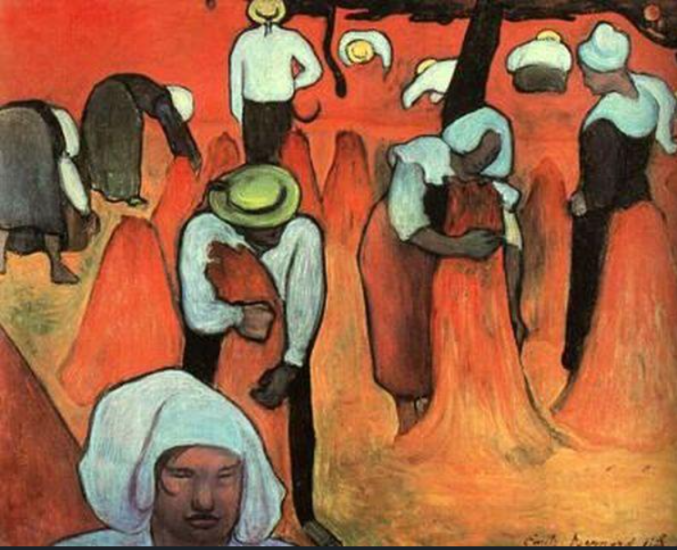
Buckwheat Harvesters at Pont Aven, Emile Bernard, Date: 1888 WikiArt
La Galette Bretonne hosted by Birgitte Kampmann, with Mary Margaret Chappell
Our most recent Kitchen Lab brought together history, technique, and shared practice in real time, as participants cooked along from their own kitchens under the warm, steady hosting of Birgitte Kampmann from Copenhagen, joined by writer and researcher Mary Margaret Chappell, broadcasting from Brittany.
As Birgitte kept the session flowing—fielding questions, cooking alongside participants, and gently steering the conversation—Mary Margaret led us deep into the world of the galette de blé noir, the buckwheat galette that is both everyday food and cultural foundation in Brittany.
Buckwheat and Brittany: A Shared History
Mary Margaret began by setting the historical and geographical context, while Birgitte anchored the discussion in practice, inviting participants to reflect on their own experiences with buckwheat as the batter rested and pans heated.
Native to northern China, buckwheat reached Europe in the late Middle Ages and found an ideal home in Brittany, where its short growing season, tolerance of poor, acidic soils, and low labor requirements made it indispensable to rural life. Known locally as blé noir or sarrasin, buckwheat is not a true grain but a seed related to rhubarb and sorrel—naturally gluten‑free, nutritionally dense, and well suited to marginal land.
As Birgitte noted while cooking along, these qualities also explain buckwheat’s renewed relevance today: resilient, adaptable, and deeply practical.
Galettes Are Not Crêpes
A key theme of the Kitchen Lab—reinforced repeatedly by both Birgitte and Mary Margaret—was that galettes are not simply savoury crêpes. In Brittany, “galette” means buckwheat crêpe, full stop: savoury, robust, and built on a deceptively simple batter of flour, water, salt, and time.
Birgitte highlighted how different flours behaved across participants’ kitchens, while Mary Margaret explained why galette batter must be spread rather than swirled, and why it often behaves better when cool rather than warm because the batter gets too thin to spread. Consistency is key because if the batter is too thick, the galette will not cook through and crack. When it’s too warm it slides around the griddle and leaves holes. This is food that teaches through doing.
Learning by Doing (and Failing)
One of the great strengths of the session was its openness to imperfection. Birgitte modelled this throughout—adjusting heat, thinning batter, showing what worked and what didn’t—while encouraging participants to keep going.
Mary Margaret shared her own steep learning curve, recalling how mastering galettes took hundreds of attempts, even after formal training. “The folds hide a world of sins,” she reminded us, as torn rounds became elegant squares and triangles.
Practical guidance emerged organically through conversation and demonstration:
- Batter should be thinner than you think
- Oil the pan lightly but consistently (butter is for flavour, not greasing)
- Cook galettes on one side only before filling
- Keep batter cool if working near high heat
- When things go wrong, fold and carry on
From Complète to Scallops
Under Birgitte’s calm facilitation, the session moved from technique to assembly. Mary Margaret demonstrated the classic galette complète—egg, cheese, and ham—while Birgitte echoed the steps on her own pan, reinforcing timing and order.
The Kitchen Lab then turned to a Breton favourite: scallops with leeks. Participants watched as Mary‑Margaret stressed restraint—scallops cooked briefly, never “seared”, finished on the galette itself—while Birgitte asked the questions many were thinking: how much filling is too much? how far can you push variation before losing the galette?
Beyond the Pan
As the session unfolded, Birgitte helped draw out wider reflections:
- galettes as street food (galette‑saucisse)
- making ahead and reheating for home cooking
- turning leftover galettes into crisp buckwheat “chips”
- adapting batters for those unable to eat buckwheat
What emerged was not a fixed recipe but a living practice—one that adapts to kitchens, climates, and hands.
Cooking as Cultural Continuity
As the Kitchen Lab drew to a close, both Birgitte and Mary Margaret returned to a shared concern: fewer people now make galettes at home, even in Brittany. What was once everyday knowledge, passed between generations, risks becoming something purchased rather than practised.
This Kitchen Lab offered a counterpoint. Through shared effort, visible mistakes, and collective problem‑solving, participants experienced galettes not as perfected objects but as process—repeatable, forgiving, and deeply human.
We are grateful to Birgitte Kampmann for hosting the session with clarity and generosity, and to Mary Margaret Chappell for sharing her scholarship, kitchen, and lived experience so openly. Thanks also to everyone who cooked along, asked questions, and kept the tradition alive—one imperfect galette at a time.


